LessonThe placenta
The placenta
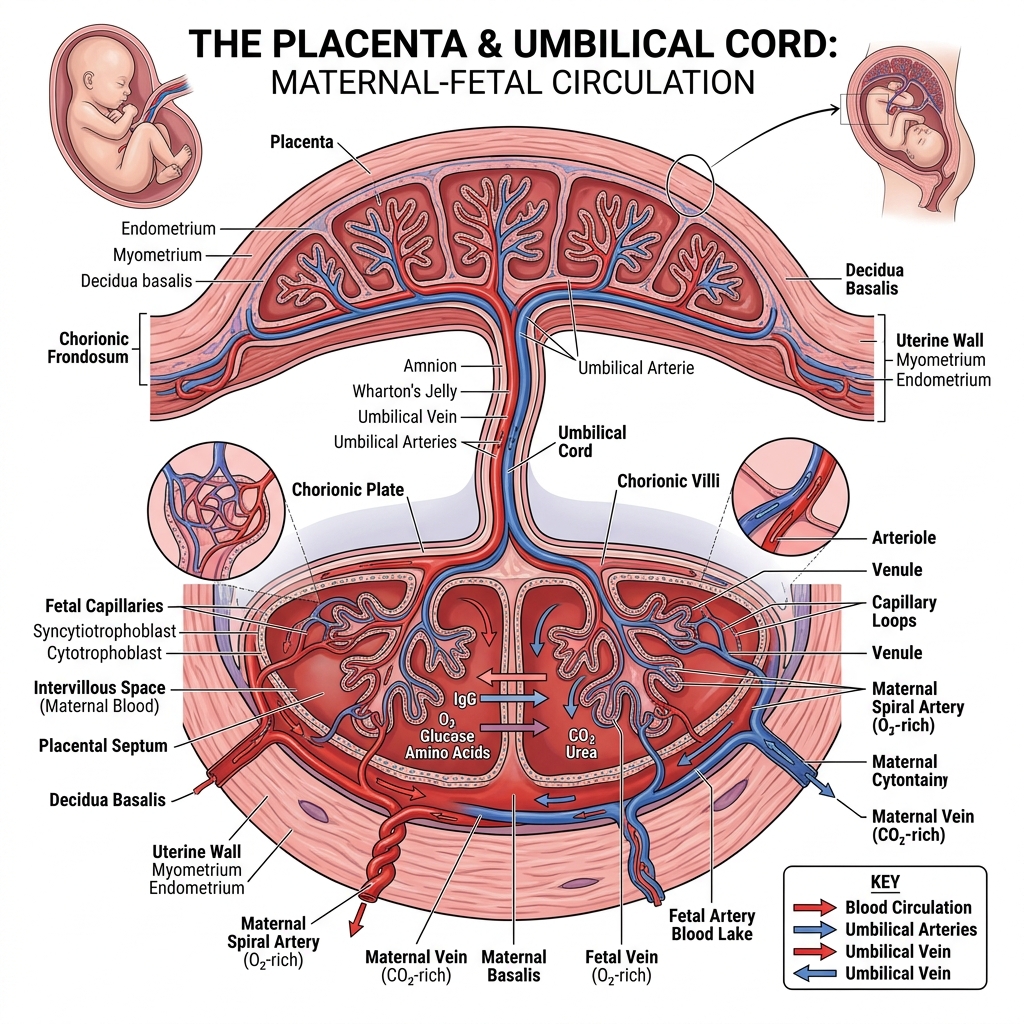
The placenta is a temporary but highly vascular, indispensable organ that forms inside the uterus during pregnancy to support fetal growth. It acts as the fetal lungs, kidneys, and digestive system while protecting against numerous pathogens.
Maternal and fetal blood do not directly mix. O2, CO2, nutrients, and waste diffuse across the placental barrier passively and actively.
Primary Functions
Respiratory
Functions as the fetal lungs. O2 diffuses from maternal to fetal circulation, while CO2 travels in the reverse direction.
Nutritional
Transfers glucose, amino acids, calcium, iron, and water from the maternal bloodstream to the fetus.
Excretory
Acts as the fetal kidneys and GI tract, removing metabolic wastes like urea and uric acid.
Endocrine
Produces hCG (maintaining early pregnancy), estrogen, progesterone, and human placental lactogen (hPL).
The Umbilical Cord Anatomy
The umbilical cord is the lifeline connecting the fetus directly to the placenta. Because fetal circulation is uniquely reversed compared to adult systemic circulation, the names of the vessels might seem initially counterintuitive:
Two Umbilical Arteries
Carry deoxygenated blood and waste products away from the fetus to the placenta.
One Umbilical Vein
Carries highly oxygenated, nutrient-rich blood towards the fetus from the placenta.
Mnemonic: Think "AVA" representing Artery - Vein - Artery indicating the 3 vessels wrapped in Wharton's Jelly.
• Key Concepts to Lock In
- → The placenta acts as lungs, kidneys, GI tract, and specialized endocrine gland for the fetus.
- → One umbilical vein delivers oxygenated blood (towards the fetal heart).
- → Two umbilical arteries return deoxygenated blood and waste to the placenta (away from the fetal heart).