LessonAlzheimer Disease
Alzheimer Disease
Alzheimer's disease is the most common cause of dementia, representing a terminal, progressive neurodegenerative process. As a paramedic, you will rarely be called for the disease itself, but rather for the devastating complications it produces: severe falls, medication errors, unmanageable agitation, or caregiver burnout.
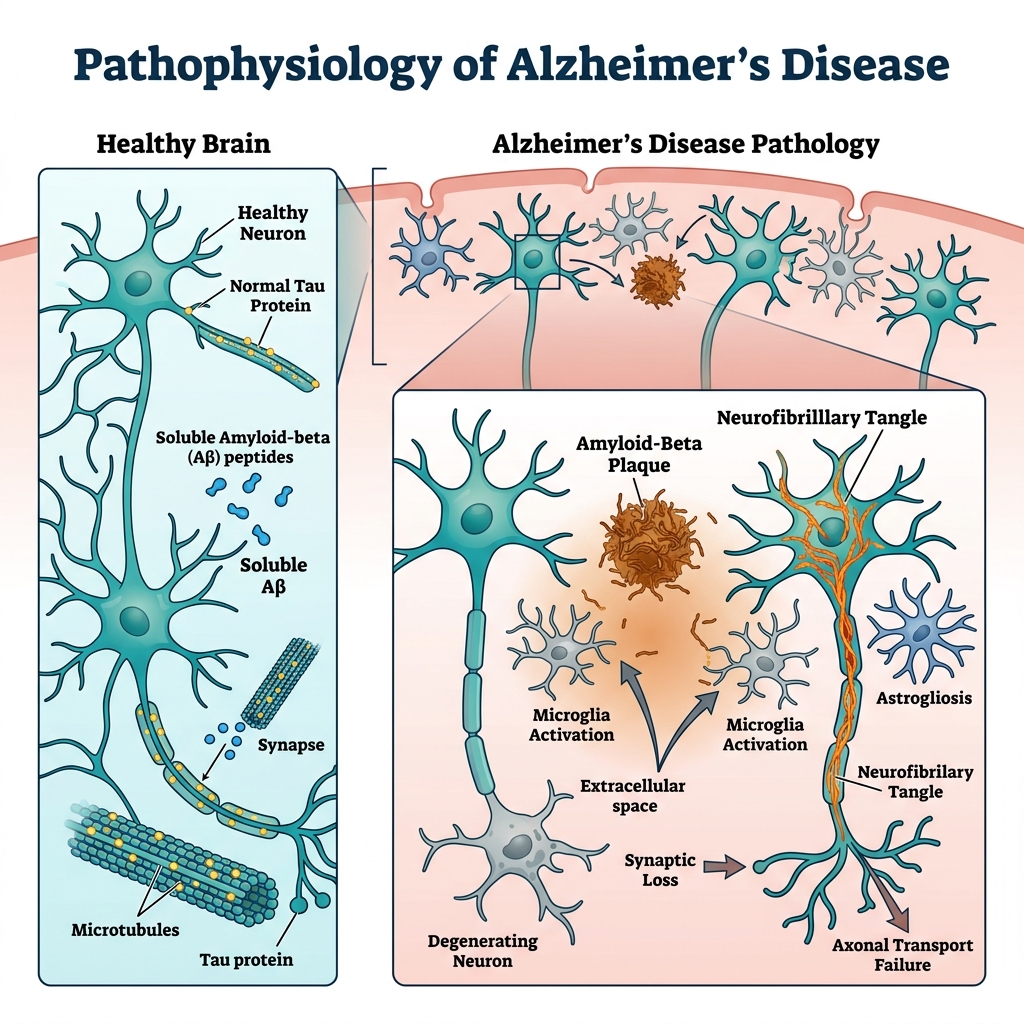
Pathophysiology & Progression
The Cellular Destruction
- Amyloid-beta Plaques Sticky protein deposits that accumulate between neurons, disrupting cellular communication and triggering chronic inflammatory responses.
- Neurofibrillary Tangles Malformed tau proteins that accumulate inside the neurons, destroying the cell's internal transport system and starving the brain cell to death.
Result: Massive, irreversible atrophy of brain tissue, starting in the hippocampus (memory formation center).
Clinical Progression
- Early: Short-term memory loss (cannot form new memories, but vividly remembers 1960).
- Moderate: Loss of executive function, confusion regarding time and place, language difficulties, behavioral agitation.
- Late/Terminal: Complete loss of daily functioning, inability to swallow, malnutrition, profound motor stiffness.
Death generally occurs via secondary complications (pneumonia, sepsis, or malnutrition) rather than the brain failure itself.
Prehospital Management
Behavioral Challenges
Patients often become terrified, paranoid, or aggressive because their brain can no longer make sense of their environment.
- Sundowning: Extreme confusion and agitation that spikes as daylight fades.
- Wandering: Patients frequently walk away from home trying to find a "past" residence or job. They are at massive risk for exposure/trauma.
- De-escalation: Do NOT attempt to logically argue with an Alzheimer's patient. Use redirection, distraction, and calming agreement.
The "Acute on Chronic" Trap
Never assume new AMS is "just their Alzheimer's getting worse."
If a dementia patient has a sudden, drastic change in behavior over 24-48 hours, they have an acute medical crisis (Delirium):
- Urinary Tract Infection (UTI)
- Pneumonia / Hypoxia
- Subdural Hematoma (from an unseen fall)
- Hypoglycemia
• Key concepts to lock in
- → Alzheimer's is characterized by physical plaques and tangles that permanently destroy brain cells.
- → A sudden, acute worsening of baseline confusion is a medical emergency requiring a full workup.
- → Never argue reality with a dementia patient. If they believe it's 1955 and they need to go to work, redirect them gently.
- → Assess the caregiver environment: Caregiver burnout is immense, and elder abuse or severe neglect is a high-risk reality in this population.