LessonPharmacokinetics
Pharmacokinetics
Pharmacokinetics is the study of how a drug moves through the body—from the moment it enters until it is eliminated.
Think: "What the body does to the drug"
(Contrast: pharmacodynamics = what the drug does to the body)
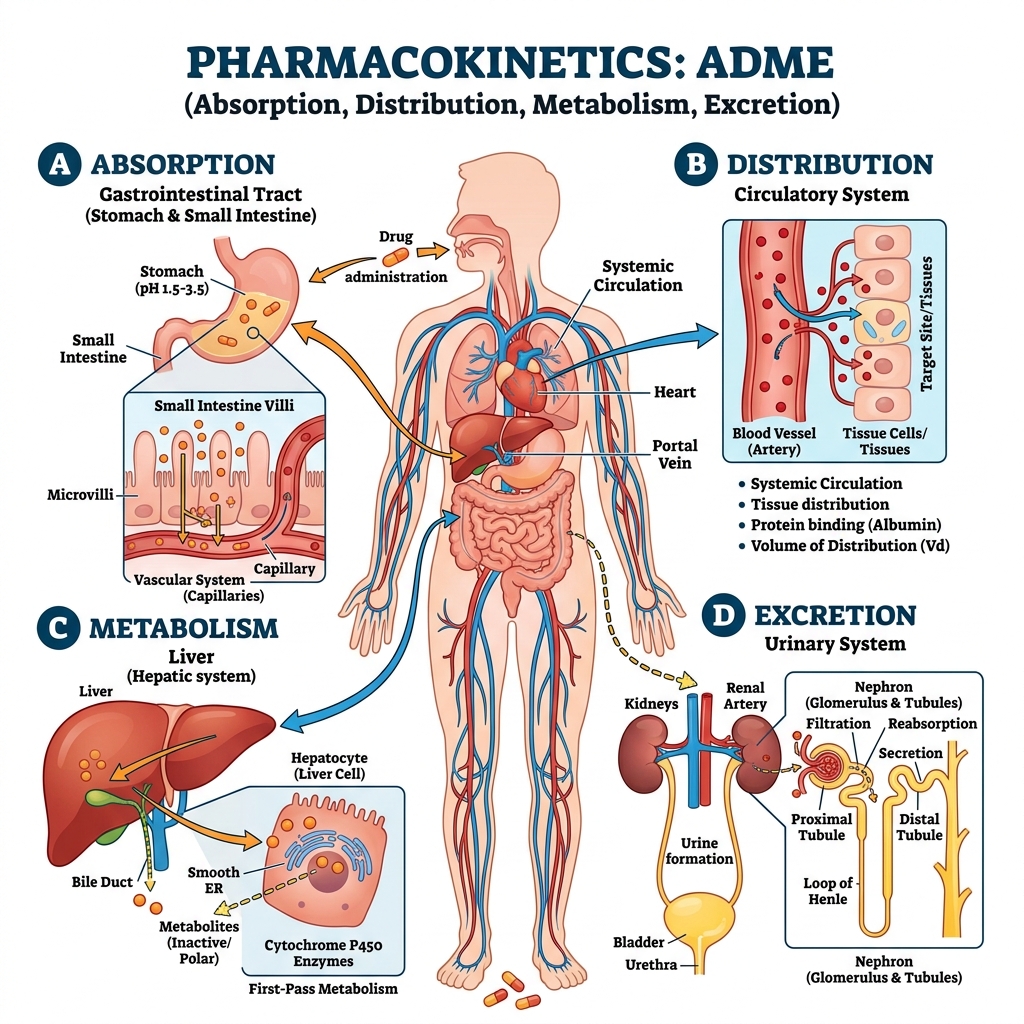
Key Components of Pharmacokinetics
How a drug enters the bloodstream.
Mechanisms:
- Passive diffusion → moves along concentration gradients
- Facilitated diffusion → uses carrier proteins
- Active transport → requires energy
- Pinocytosis → cell "engulfing" of substances
Bioavailability:
Percentage of drug that reaches systemic circulation.
IV / IO = 100% bioavailability
Other routes may lose drug due to breakdown or incomplete absorption.
How the drug spreads throughout the body.
Volume of Distribution (Vd)
- Theoretical space the drug occupies in the body
- Helps determine drug concentration in plasma
Protein Binding
Drugs travel in two forms:
- Bound (inactive reservoir)
- Unbound (active form)
👉 Only unbound drug can leave the bloodstream, reach tissues, and produce effects.
Chemical changes.
Chemical changes made to a drug after it enters the body.
Purpose:
- Convert inactive drugs into active forms (prodrugs)
- Make drugs more water-soluble for elimination
Processing.
How the body chemically processes a drug.
- Primarily occurs in the liver
- Uses enzymes to modify drugs
The First-Pass Effect
Drugs taken orally face an obstacle course before reaching the entire body:
👉 The liver may break down a large portion before it reaches circulation, reducing drug availability.
Bypassing First-Pass Metabolism:
5. Excretion
How the body eliminates drugs.
Primary Routes
- Kidneys (most important) → urine
- Liver/bile → feces
- Lungs → gases (e.g., anesthetics)
Minor Routes
- Sweat
- Saliva
- Breast milk
⚠️ Drugs in breast milk can affect infants.
Big Picture Summary
Every drug follows this path:
- • Liver metabolism increases water solubility → easier excretion
- • Kidneys remove water-soluble substances
- • Biliary system prevents reabsorption by sending drugs to stool