LessonSympathetic vs Parasympathetic Nervous Systems
Sympathetic vs Parasympathetic
The autonomic nervous system has two main divisions that produce vastly opposite effects on the body. They function to maintain homeostasis involuntarily.
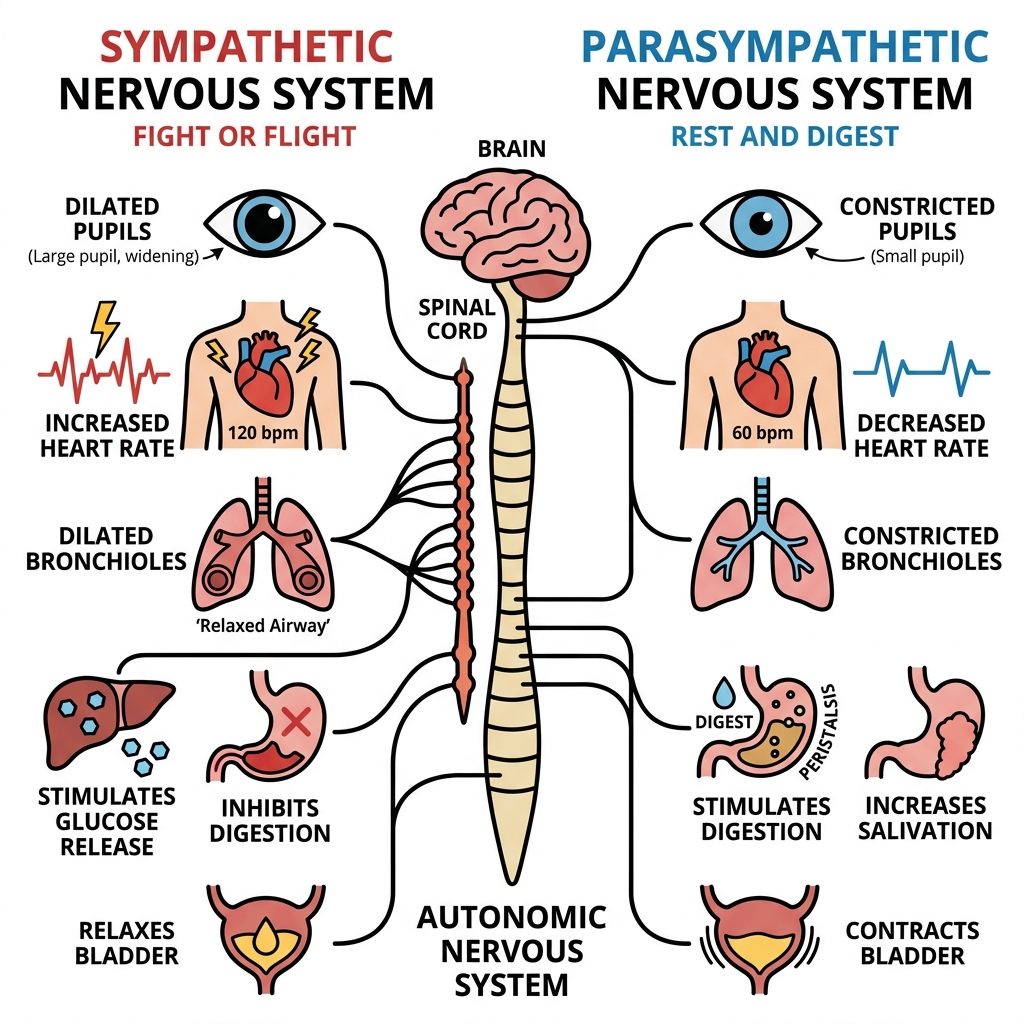
Anatomical Organization
Do not confuse spinal nerves with the autonomic nervous system. Only spinal nerves fully exit the vertebral column. The autonomic networks travel alongside them.
Sympathetic (Fight or Flight)
- Originates from the Thoracic & upper Lumbar spinal cord.
- Thoracolumbar Outflow
- Fibers synapse in a long chain of ganglia located right next to the spine.
- Designed for widespread, rapid coordinated activation across the whole body simultaneously.
Parasympathetic (Rest & Digest)
- Originates from the Brainstem (Cranial Nerves) and Sacral spinal cord.
- Craniosacral Outflow
- Fibers synapse very close to, or actually inside, the target organ.
- Designed for targeted, isolated responses without a generalized body reaction.
Physiological Effects
Target Organ
Sympathetic
Parasympathetic
Pupils
Dilates
Constricts
Cardiovascular
- Increases Heart Rate
- Raises Blood Pressure
- Redirects blood to muscles
- Decreases Heart Rate
- Lowers Blood Pressure
- Promotes GI blood flow
Respiratory
Bronchodilation (Opens)
Bronchoconstriction (Baseline)
Digestive
Decreases motility & secretions
Increases motility & secretions
Adrenals / Skin
Releases Epi / Sweating
Reduces / No direct effect
Key Takeaway
These systems exist on a seesaw. Knowing these patterns allows Paramedics to instantly recognize if a patient matches a sympathetic response (Shock) or a toxic parasympathetic overdose (Organophosphates).